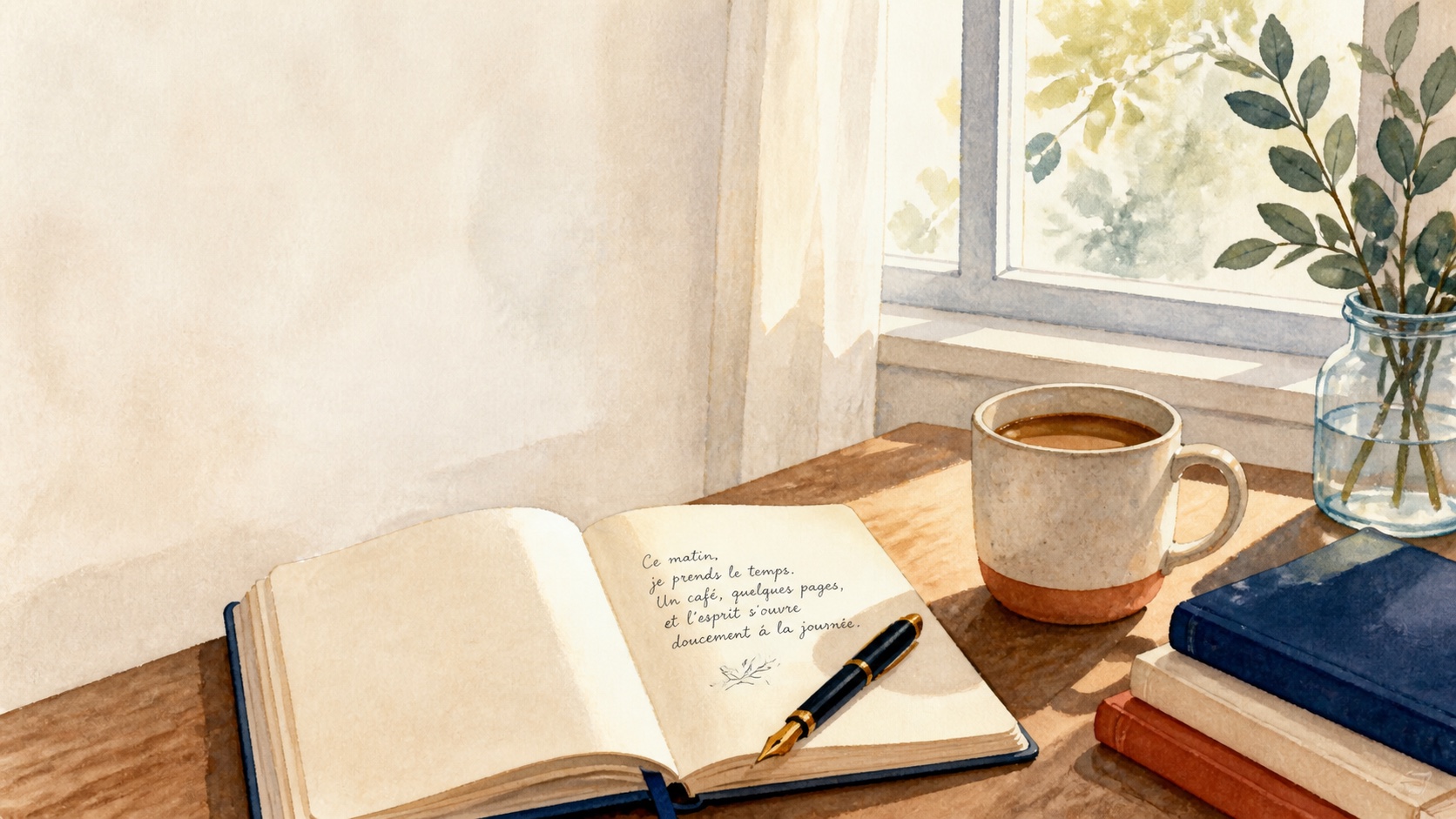
Talking about daily habits in French is not only about listing everything you do from morning to evening. Very often, a small repeated action says something more personal: how you begin your day, create a pause, find your bearings or make a moment feel like your own.
In this guide, you will discover useful French vocabulary, natural expressions and sentence patterns to help you speak or write about a daily habit in a more precise and personal way.
You do not need to learn every expression. Choose two or three that fit a real habit in your life, then try to reuse them in your own sentences.
1. How to introduce a daily habit in French
French offers several ways to introduce something you do regularly. The best expression depends on whether the habit is already established, recently acquired or simply part of your day.
Avoir l’habitude de
Avoir l’habitude de + infinitive means to be in the habit of or to usually do something.
- J’ai l’habitude de boire un café près de la fenêtre avant de commencer à travailler.
- Nous avons l’habitude de faire une promenade après le dîner.
Prendre l’habitude de
Prendre l’habitude de describes a habit that is developing or that you have deliberately introduced.
- J’ai pris l’habitude d’écrire quelques lignes avant de me coucher.
- Depuis que je travaille chez moi, j’ai pris l’habitude de sortir à l’heure du déjeuner.
Faire partie de sa journée
When a ritual feels firmly integrated into your life, you can say that it fait partie de votre journée.
Ce moment de lecture fait partie de ma journée. Même dix minutes me suffisent.
Useful time expressions
- tous les matins / tous les soirs — every morning / every evening
- chaque jour — every day
- le matin / le soir — in the morning / in the evening, as a general habit
- chaque fois que… — every time that…
- en général — generally
- la plupart du temps — most of the time
Notice the difference:
- Le matin, je bois du thé. — This is my usual morning habit.
- Ce matin, j’ai bu du thé. — This refers to one particular morning.
2. Useful verbs for describing a small daily ritual
You may already know verbs such as se lever, manger and travailler. To make your description more precise, choose verbs that show the small actions and sensations inside the ritual.
- ouvrir les volets / les rideaux — to open the shutters / curtains
- préparer du café ou du thé — to make coffee or tea
- s’installer près de la fenêtre — to settle down near the window
- prendre l’air — to get some fresh air
- faire quelques pas — to walk for a few minutes
- feuilleter un livre ou un magazine — to leaf through a book or magazine
- noter une idée — to write down an idea
- s’accorder quelques minutes — to allow oneself a few minutes
- savourer un moment — to savour a moment
- faire une pause — to take a break
Instead of writing only:
Je bois un café tous les matins.
You could write:
Tous les matins, je prépare un café et je m’installe quelques minutes près de la fenêtre. J’ouvre mon carnet, je note une idée et je regarde la rue s’animer.
3. Connect the different actions naturally
A ritual is often made up of several small actions. Connecting them clearly will make your French sound more fluid and prevent your paragraph from becoming a list of short sentences.
D’abord, puis, ensuite, enfin
D’abord, j’ouvre les volets. Puis, je prépare du thé. Ensuite, je m’assieds quelques minutes dans la cuisine. Enfin, j’allume mon ordinateur.
These connectors are useful, but you do not need one in every sentence. You can also vary your structures.
Avant de + infinitive
Use avant de when the subject of both actions is the same.
- Je lis quelques pages avant de m’endormir.
- Avant de commencer ma journée, je prends le temps de regarder dehors.
Après avoir / après être + past participle
Use après avoir or après être to show that one action is completed before the next one begins.
- Après avoir préparé mon café, je m’installe dans le salon.
- Après être sortie du travail, je marche quelques minutes avant de rentrer chez moi.
Dès que
Dès que means as soon as.
Dès que je rentre chez moi, j’enlève mes chaussures et je mets un peu de musique.
Pendant que
Pendant que connects two actions happening at the same time.
J’écoute la radio pendant que je prépare le petit-déjeuner.
4. Natural French expressions for talking about a meaningful ritual
A small habit may be ordinary and still matter to you. These expressions help you explain what the ritual gives you, rather than simply describing the actions.
Prendre le temps de
Prendre le temps de means to make or take the time to do something, instead of rushing.
Le soir, je prends le temps de préparer une vraie tasse de thé.
Tenir à
Tenir à quelque chose means that it is important to you and that you want to preserve it.
Je tiens à ce petit moment de calme avant que la journée commence.
Ne pas pouvoir se passer de
Ne pas pouvoir se passer de means that something has become difficult to do without.
Je ne peux plus me passer de ma promenade du soir.
Cela me permet de
This structure is useful for explaining the effect or purpose of a habit.
Écrire quelques lignes me permet de mettre de l’ordre dans mes idées.
Être devenu un repère
A habit can become un repère: something familiar that gives structure to your day.
Cette courte promenade est devenue un repère dans ma journée.
Ne manquer quelque chose pour rien au monde
This expression emphasises how attached you are to a moment or activity.
Je ne manquerais ce moment pour rien au monde.
5. Use “depuis” and “depuis que” to explain when the habit began
Use depuis when a habit began in the past and is still continuing now.
Depuis + a duration or starting point
- Je fais cette promenade depuis trois ans.
- J’écris dans ce carnet depuis le mois de janvier.
- Nous déjeunons ensemble le dimanche depuis notre arrivée à Oxford.
Depuis que + a conjugated verb
Use depuis que before a complete clause.
- Depuis que je travaille chez moi, je sors marcher tous les midis.
- Depuis que j’ai déménagé, je commence chaque journée près de cette fenêtre.
In French, the present tense is normally used for an action that started in the past and is still happening:
- Correct: Je fais cela depuis deux ans.
- Not natural in this context: J’ai fait cela depuis deux ans.
6. Talk about a habit that changed or gradually appeared
Se mettre à + infinitive
Se mettre à means to start doing something.
L’hiver dernier, je me suis mise à lire quelques pages chaque soir.
Finir par + infinitive
Finir par describes the result of a gradual process. It is close to to end up doing something.
Au début, je devais y penser. Puis j’ai fini par faire cette promenade naturellement.
Avoir tendance à
Avoir tendance à is useful for something you often do, especially when the habit is not completely fixed.
Quand je suis pressée, j’ai tendance à oublier ce moment de pause.
You can also use ne plus for a habit that has stopped and encore for one that continues:
- Je ne prends plus mon téléphone dès que je me réveille.
- Je lis encore quelques pages avant de dormir.
7. Example: describing a daily ritual in natural French
Here is an example that brings several of these expressions together:
Tous les matins, avant d’allumer mon ordinateur, je prépare du café et je m’installe près de la fenêtre avec un petit carnet. Je prends le temps d’écrire une phrase ou deux, sans chercher à raconter quelque chose d’important. Parfois, je note simplement la lumière, le temps qu’il fait ou une idée qui m’est venue pendant la nuit. J’ai pris cette habitude depuis que je travaille chez moi. Au début, je devais me rappeler d’ouvrir le carnet, mais j’ai fini par attendre ce moment avec impatience. Il est devenu un repère dans ma journée. Quand je suis pressée, j’ai tendance à le supprimer, et je sens immédiatement que ma matinée commence autrement.
Notice that the paragraph does more than list a sequence of actions. It explains when the ritual began, how it became established and what changes when the person cannot follow it.
8. A short French writing prompt
Choose a small ritual that forms part of your day or week. It can be preparing a drink, walking somewhere, listening to the radio, reading, writing, opening a window or taking a few quiet minutes.
Write a short paragraph and include:
- when you usually do it;
- the small actions that make up the ritual;
- when or why you began;
- what this moment gives you;
- what happens when you cannot do it.
Try to use at least two of these expressions:
- avoir l’habitude de
- prendre le temps de
- depuis que…
- être devenu un repère
- finir par + infinitive
A few sentences are enough. The aim is not to describe a perfect routine, but to find the French words for a small moment that genuinely belongs to you.
Move from recognising French to using it
Reading vocabulary and grammar explanations can help you recognise more French. But to make the language available when you need it, you also need to use it in your own sentences, return to it and receive feedback on what you write or say.
Inside Write Your French, we explore one shared theme each week through listening, writing and speaking. You can choose the activities that interest you, publish your texts, dictations or voice messages, and receive my personal corrections and suggestions for more natural French.
You do not have to complete everything, and there is nothing to catch up on. You simply begin with the words you have and gradually make them more precise, more natural and more your own.
Listen. Find your words. Make French your own.